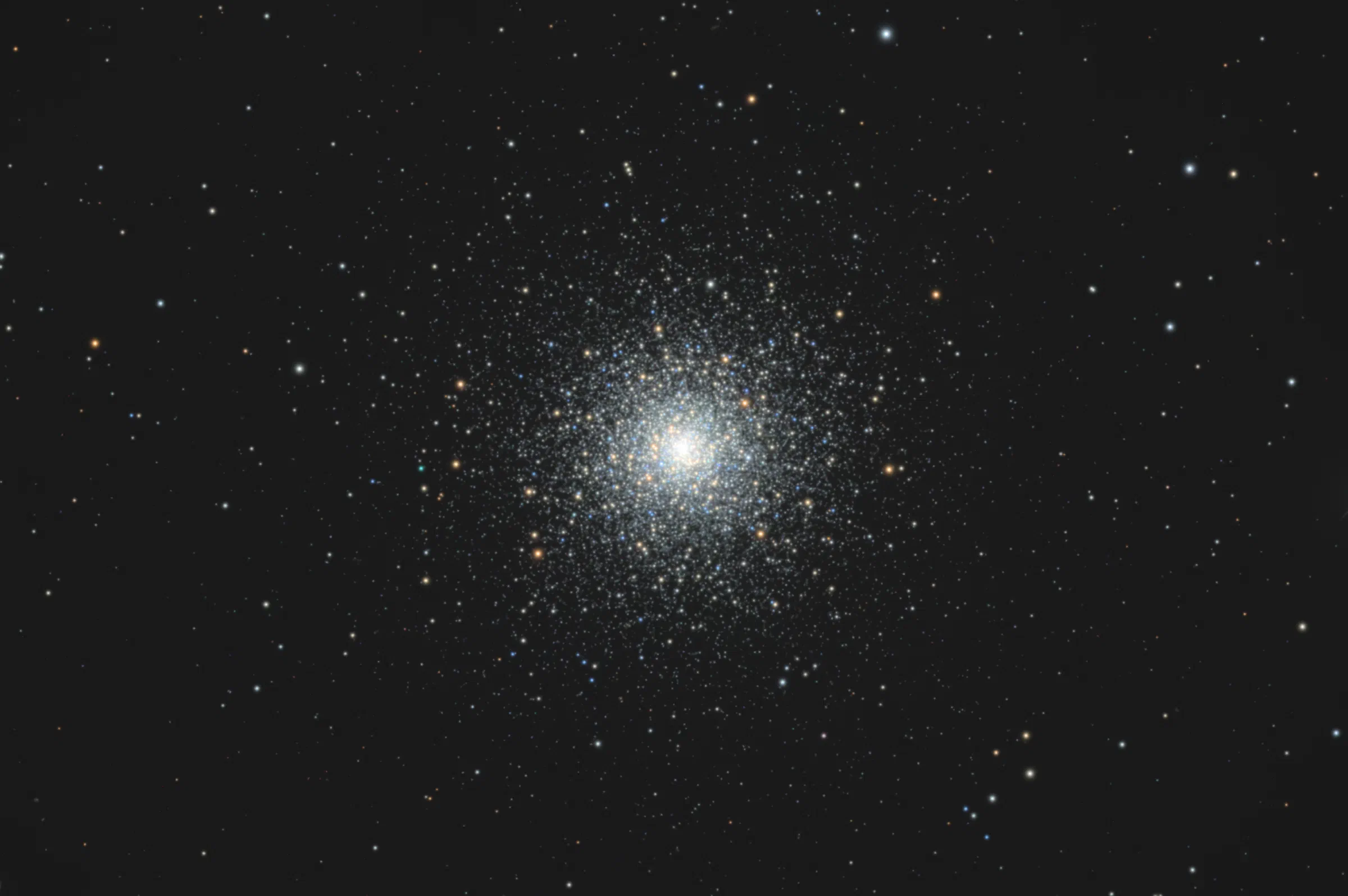
NGC 1851: Globular Cluster in Columba
“A dense globular cluster in the southern constellation Columba, about 39,500 light-years away, with a very compact core and an extended halo.”
NGC 1851 is a globular cluster in the constellation Columba, about 39,500 light-years away. It is roughly 11 arcminutes across and has an apparent magnitude of about 7.3. James Dunlop discovered it in 1826. Its core is very compact, with a halo of stars extending well beyond it, and the long focal length resolves the outer regions into individual stars.
Its stars do not all share the same history: the subgiant branch splits into two populations, and the horizontal branch also shows two groups of stars. This has led to proposals that NGC 1851 is the product of a merger of two clusters, or the stripped nucleus of a dwarf galaxy absorbed by the Milky Way. The question is still debated.
Only red, green and blue data was used, so the colours of the stars come directly from the three filters.
The data was captured remotely from Swan Reach, South Australia, in a single night, in collaboration with Paride Gabini, Rino Morra, Federico Palaia and Alessio Carmine Scipione, on a rig operated with NINA at Swan Reach Imaging (https://swanreachimaging.com.au). The frames were collected jointly by the group sharing the rig. Stacked and processed in PixInsight.
Integration
| Filter | Subs |
|---|---|
| R | 27 x 180s (1h 21m) |
| G | 27 x 180s (1h 21m) |
| B | 15 x 180s (45m) |