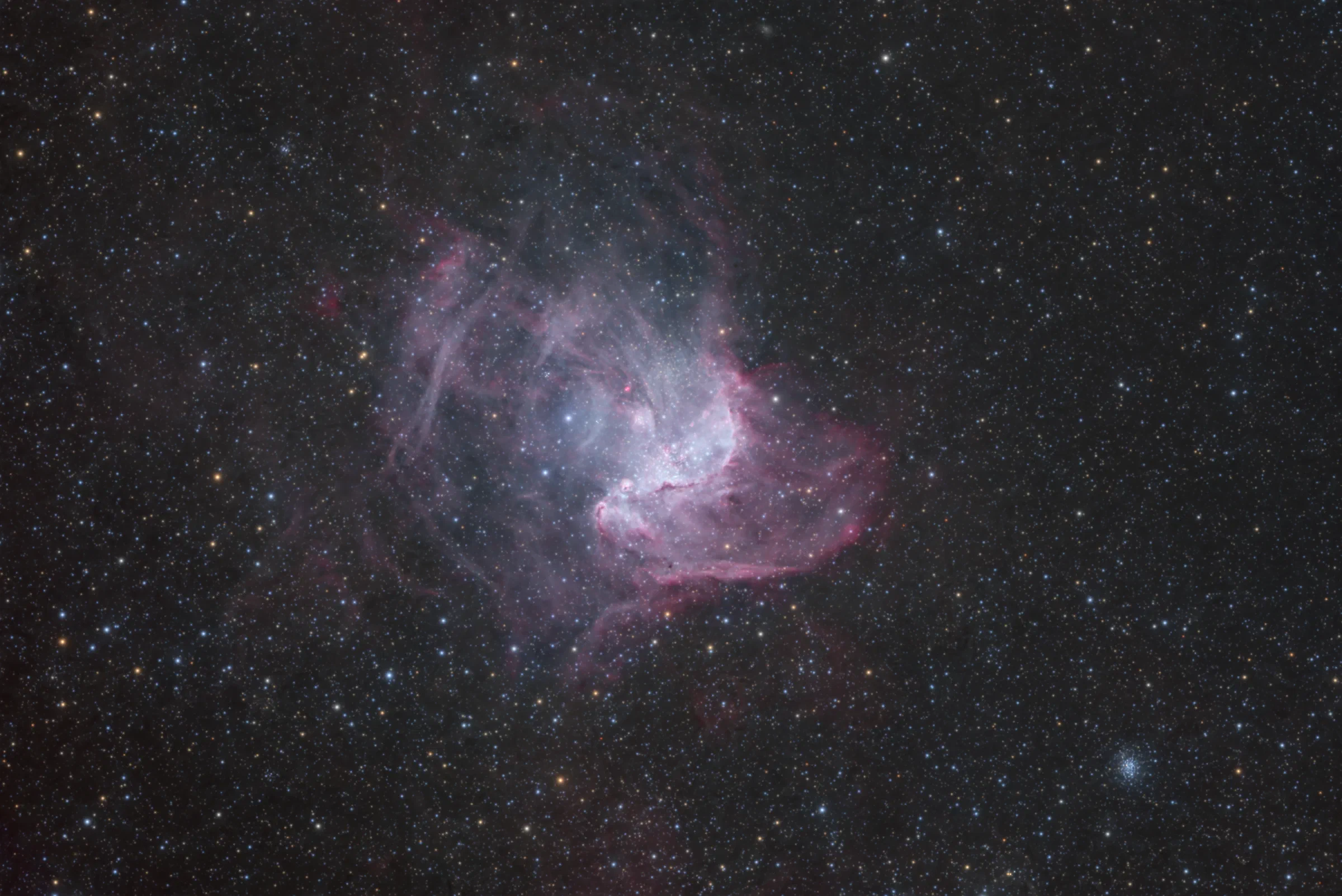
NGC 346: Star-Forming Nebula in the Small Magellanic Cloud
“The brightest star-forming region of the Small Magellanic Cloud: a young open cluster wrapped in glowing hydrogen gas, about 200,000 light-years away in Tucana.”
NGC 346 is a young open cluster with an associated nebula in the constellation Tucana, about 200,000 light-years away. It lies near the centre of N66, the brightest H II region of the Small Magellanic Cloud, a satellite galaxy of the Milky Way. About thirty of its stars are hot, massive stars of spectral type O, and their radiation ionises the surrounding hydrogen. James Dunlop discovered it in 1826.
The Small Magellanic Cloud contains lower concentrations of elements heavier than hydrogen and helium than the Milky Way, so its star-forming regions resemble the conditions of galaxies billions of years ago. NGC 346 has also been observed by the James Webb Space Telescope, which found more dust there than expected.
The H-alpha data shows the structure of the nebula, and the red, green and blue frames add the colour of the stars. The target lies too far south to be observed from Italy.
The data was captured remotely from Swan Reach, South Australia, in a single night, in collaboration with Paride Gabini, Rino Morra, Federico Palaia and Alessio Carmine Scipione, on a rig operated with NINA at Swan Reach Imaging (https://swanreachimaging.com.au). The frames were collected jointly by the group sharing the rig. Stacked and processed in PixInsight.
Integration
| Filter | Subs |
|---|---|
| Ha | 23 x 300s (1h 55m) |
| R | 10 x 120s (20m) |
| G | 9 x 120s (18m) |
| B | 10 x 120s (20m) |