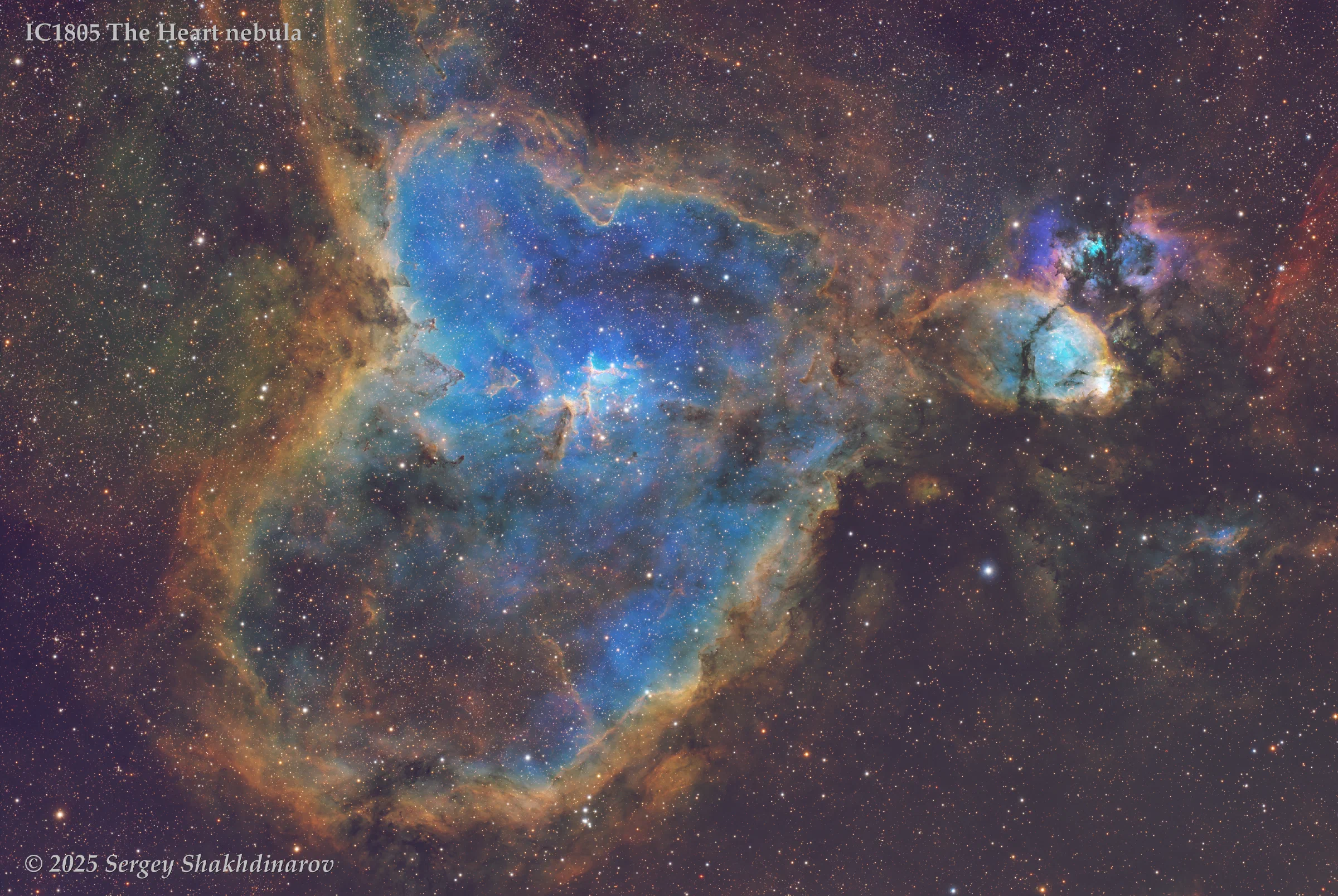
IC 1805: The Heart Nebula in SHO
“A spectacular narrowband image of the Heart Nebula in the Hubble palette, showcasing the intricate pillars of gas and dust shaped by the central star cluster Melotte 15.”
This spectacular image presents IC 1805, famously known as the Heart Nebula, captured using narrowband filters and processed in the classic Hubble Space Telescope (SHO) color palette. Located about 7,500 light-years away in the constellation Cassiopeia, this massive emission nebula is sculpted by the intense stellar winds and ultraviolet radiation from the young, central open star cluster known as Melotte 15.
The deep narrowband data—where Sulfur-II is mapped to red, Hydrogen-alpha to green, and Oxygen-III to blue—reveals the complex dynamics of the glowing gas and the silhouette of dark dust lanes in striking detail. To preserve a natural look for the starry background, broadband RGB data was also collected and blended specifically to render the stars in their true colors.
IC 1805 lies in the Perseus Arm and spans almost 2 degrees of sky. William Herschel discovered it on 3 November 1787. Melotte 15 contains a few stars of nearly 50 solar masses, and the brightest part of the nebula, a knot at its western edge, is catalogued as NGC 896.
Stacked and processed in PixInsight.
Equipment
Integration
| Filter | Subs |
|---|---|
| Ha (6nm) | 26 x 600s (4h 20m) |
| SII (3nm) | 28 x 600s (4h 40m) |
| OIII (3nm) | 30 x 600s (5h 00m) |
| R | 10 x 300s (50m) |
| G | 10 x 300s (50m) |
| B | 10 x 300s (50m) |