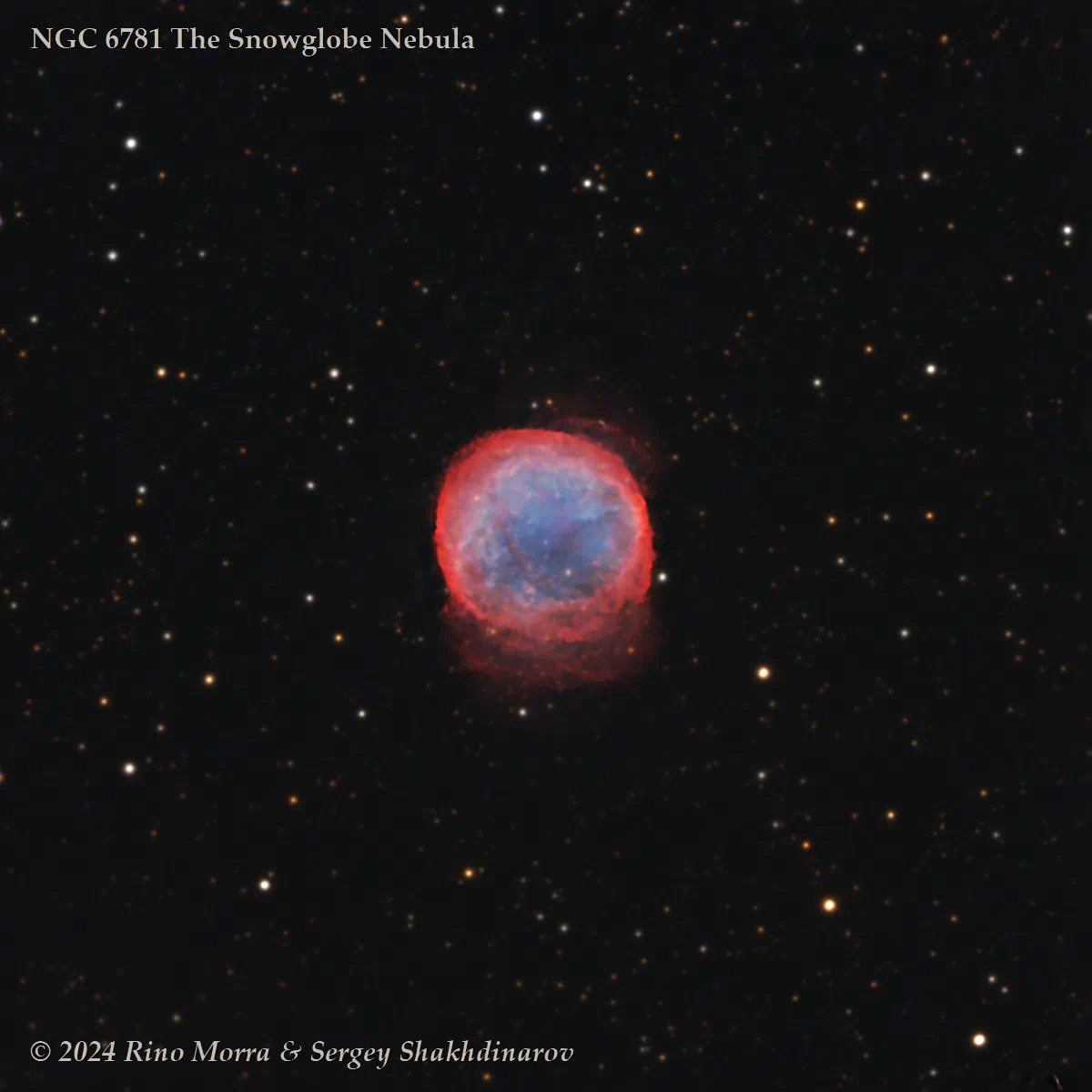
NGC 6781: The Snowglobe Nebula
“A stunning planetary nebula in Aquila, featuring a glowing blue core of ionized oxygen surrounded by a delicate red shell of hydrogen.”
This image captures NGC 6781, widely known as the Snowglobe Nebula, a beautiful planetary nebula located in the constellation Aquila. The bubble-like structure is formed by the outer layers of a dying sun-like star being cast off into space. The intense ultraviolet radiation from the exposed white dwarf core illuminates the expanding gas, creating the distinct color separation seen here: a hot, glowing blue center dominated by ionized oxygen (OIII) and a cooler, delicate red outer shell composed primarily of hydrogen (H-alpha).
This image is a collaborative capture by Rino Morra and Sergey Shakhdinarov.
NGC 6781 is about 1,500 light-years away and measures 1.9 by 1.8 arcminutes, with a physical radius of about 0.44 light-years. William Herschel discovered it on 30 July 1788. Its dust shell is believed to be barrel-shaped and seen nearly pole-on. The white dwarf at its centre, of magnitude 16.9, descends from a star of about 2.5 solar masses that left the asymptotic giant branch about 9,400 years ago.
Stacked and processed in PixInsight.
Integration
| Filter | Subs |
|---|---|
| L | 25 x 600s (4h 10m) |